GENIAL! Basic Ontology
Release: 2024-09-12
- This version:
- http://w3id.org/gbo/0.2.4
- Latest version:
- http://w3id.org/gbo
- Revision:
- 0.2.4
- Authors:
- Frank Wawrzik
- Contributors:
- Christoph Grimm
- Peter Neumann
- Imported Ontologies:
- bfo.owl
- Download serialization:


- License:

- Visualization:

- Cite as:
- Frank Wawrzik. GENIAL! Basic Ontology. Revision: 0.2.4. Retrieved from: http://w3id.org/gbo/0.2.4
- Vocabulary maintained at:
- https://github.com/wawrzik/GENIALOntologies/tree/master/OntologyModuleSuite/GENIAL!BasicOntology
Abstract
The GENIAL! Basic Ontology is a heavyweight ontology built for the structuring of and reasoning with system and electronic engineering artifacts.Introduction back to ToC
The GENIAL! Basic Ontology (GBO) was designed to describe the areas of systems engineering and electronic development. The goal is to be able to consistenly describe systems and their parts in a physical way, but also with all its related factors for their development. Thus their properties, their functions, requirements and their dependencies can also be described. This ontology facilitates building complete knowledge bases for electronic devices, in comparison to for example the semantic sensor network ontology or the digital reference ontology. This is due to its structure and selected terms, which can represent these devices as a whole.GBO is built upon two features. The first one includes the incorporation and usage of the Basic Formal Ontology (BFO). All concepts are aligned with BFO and BFO's design principles are consistently applied to GBO and the knowledge base content that is created with GBO. Further GBO is built according to the ISO26262 standard in automotive electronic safety, which makes electronic safety and automotive development a related topic. The second feature is a heavyweight approach to ontology modelling. The definitions of ISO26262 have been formalized meticulously and are available for reasoning purposes. GBO is intended to be specifically used with reasoners in order to improve the overall quality of knowlege bases or knowledge graphs built with GBO. This is a different approach than how most ontologies are currently built. The goal is to build an extensive high quality knowledge base of systems and electronic engineering. One application, but not limited to it, is the exchange of knowledge in the automotive value chain. Key terms to describe physical systems are: system, hardware, software, component, hardware component, hardware part, hardware subpart, hardware elementary subpart, software component and software unit.
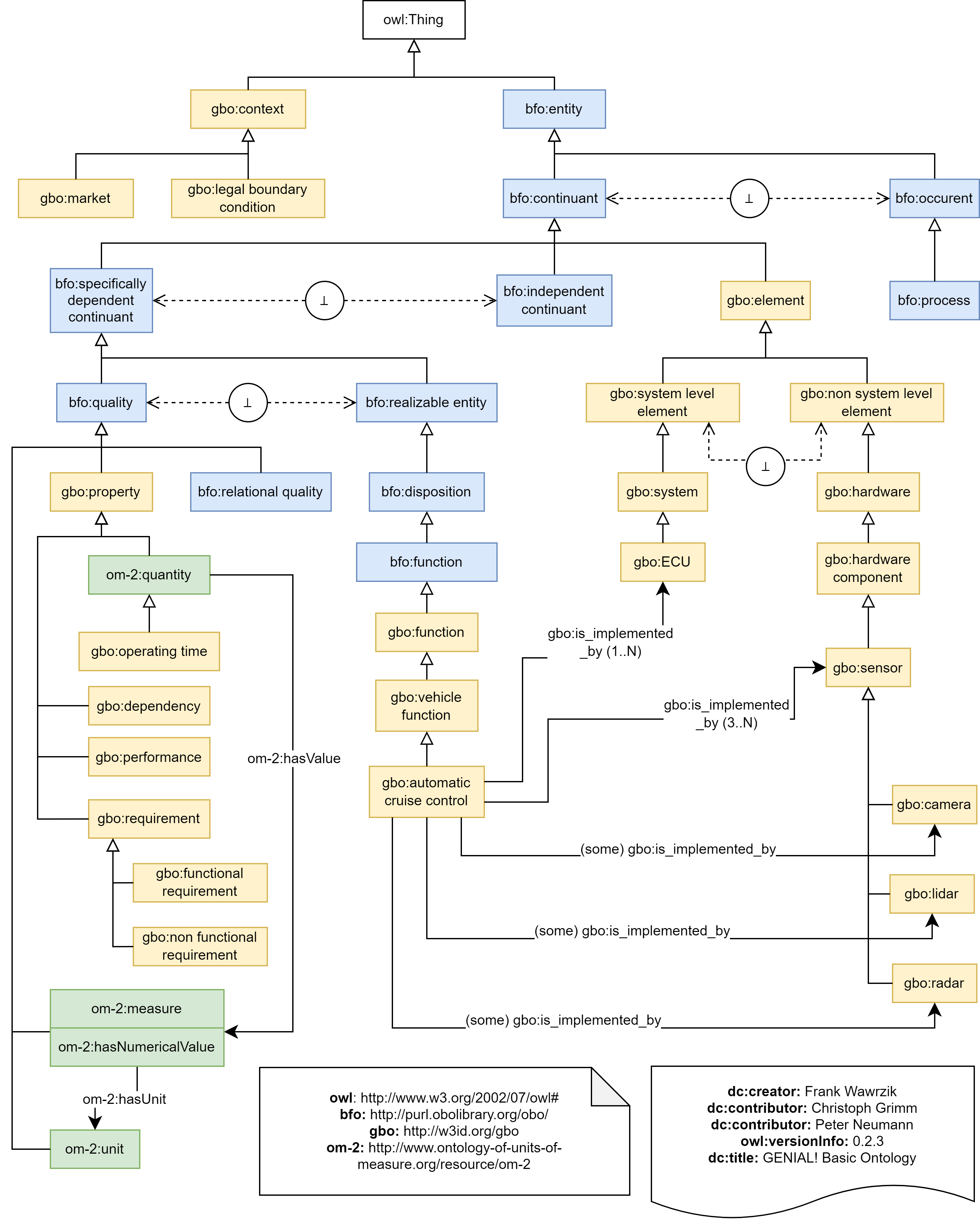
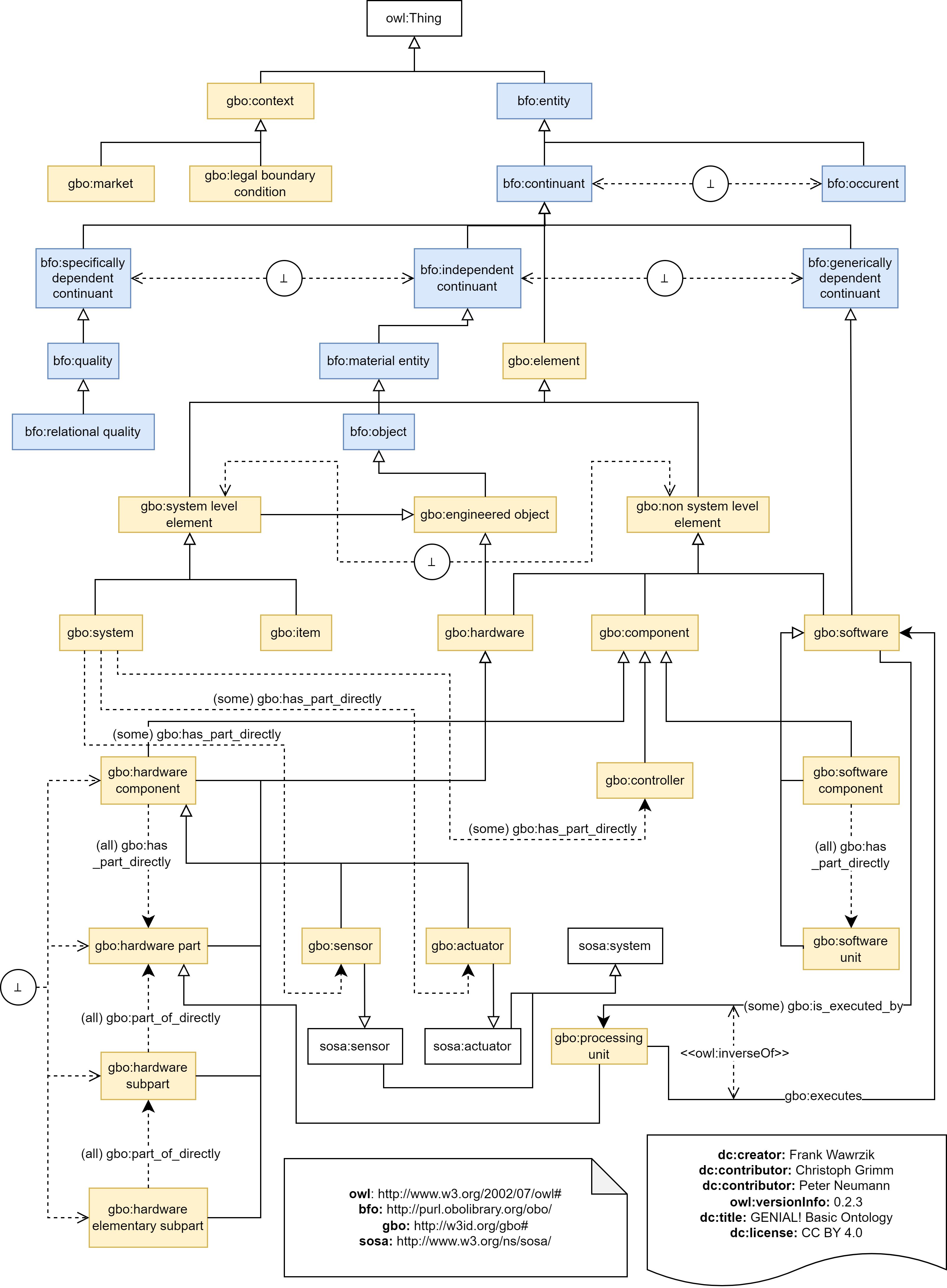
Figure 1 gives a core overview of the physical parts of the ontology and how they are aligned with BFO. Figure 2 gives a core overview with functions and properties. Both Figures are identical for version 0.2.3 and 0.2.4.
Namespace declarations
| [Ontology NS Prefix] | <http://w3id.org/gbo> |
| dc | <http://purl.org/dc/elements/1.1/> |
| foaf | <http://xmlns.com/foaf/0.1/> |
| gbo | <http://w3id.org/gbo#> |
| obo | <http://purl.obolibrary.org/obo/> |
| om-2 | <http://www.ontology-of-units-of-measure.org/resource/om-2/> |
| owl | <http://www.w3.org/2002/07/owl#> |
| rdf | <http://www.w3.org/1999/02/22-rdf-syntax-ns#> |
| rdfs | <http://www.w3.org/2000/01/rdf-schema#> |
| sosa | <http://www.w3.org/ns/sosa/> |
| terms | <http://purl.org/dc/terms/> |
| vann | <http://purl.org/vocab/vann/> |
| xml | <http://www.w3.org/XML/1998/namespace> |
| xsd | <http://www.w3.org/2001/XMLSchema#> |
GENIAL! Basic Ontology: Overview back to ToC
This ontology has the following classes and properties.Classes
- actuating
- actuator
- automatic cruise control
- camera
- component
- context
- controller
- dependency
- ECU
- element
- embedded software
- engineered object
- function
- functional requirement
- hardware
- hardware component
- hardware elementary subpart
- hardware part
- hardware subpart
- item
- legal boundary conditon
- lidar
- market
- material object
- measure
- mechanical object
- non functional requirement
- non system level element
- operating time
- performance
- processing
- processing element
- property
- quantity
- radar
- requirement
- sensing
- sensor
- social object
- software
- software component
- software unit
- system
- system level element
- unit
- vehicle function
Object Properties
GENIAL! Basic Ontology: Description back to ToC
Basic Ontology with general vocabulary for serving as a ground to execute basic tasks of the tool AGILA and share common upper level for all classes in GENIAL!. It supports the modelling of microlectronic components like sensors, acutators, processors and software along the automotive value chain.Cross-reference for GENIAL! Basic Ontology classes, object properties and data properties back to ToC
This section provides details for each class and property defined by GENIAL! Basic Ontology.Classes
- actuating
- actuator
- automatic cruise control
- camera
- component
- context
- controller
- dependency
- ECU
- element
- embedded software
- engineered object
- function
- functional requirement
- hardware
- hardware component
- hardware elementary subpart
- hardware part
- hardware subpart
- item
- legal boundary conditon
- lidar
- market
- material object
- measure
- mechanical object
- non functional requirement
- non system level element
- operating time
- performance
- processing
- processing element
- property
- quantity
- radar
- requirement
- sensing
- sensor
- social object
- software
- software component
- software unit
- system
- system level element
- unit
- vehicle function
actuatingc back to ToC or Class ToC
IRI: http://w3id.org/gbo#actuating
- has super-classes
- function c
- is disjoint with
- hardware elementary subpart c
actuatorc back to ToC or Class ToC
IRI: http://w3id.org/gbo#actuator
- has super-classes
- Actuator c, hardware component c
automatic cruise controlc back to ToC or Class ToC
IRI: http://w3id.org/gbo#automatic_cruise_control
- has super-classes
- vehicle function c
componentc back to ToC or Class ToC
IRI: http://w3id.org/gbo#component
- Example
-
A microcontroller
- is equivalent to
- non system level element c and (((comprised of op some hardware part c) and (comprised of op min 2 hardware part c)) or ((comprised of op some software component c) or (comprised of op some software unit c))) and (part of directly op some system c)
- has sub-classes
- controller c, hardware component c, software component c
contextc back to ToC or Class ToC
IRI: http://w3id.org/gbo#context
- has sub-classes
- legal boundary conditon c, market c
controllerc back to ToC or Class ToC
IRI: http://w3id.org/gbo#controller
- has super-classes
- component c
dependencyc back to ToC or Class ToC
IRI: http://w3id.org/gbo#dependency
- has super-classes
- property c
- is in range of
- depends on op
ECUc back to ToC or Class ToC
IRI: http://w3id.org/gbo#electronic_control_unit
- has super-classes
- system c
elementc back to ToC or Class ToC
IRI: http://w3id.org/gbo#element
- has super-classes
- B F O 0000002 c
- has sub-classes
- non system level element c, system level element c
- is in domain of
- has property op, implements op
- is in range of
- is implemented by op
embedded softwarec back to ToC or Class ToC
IRI: http://w3id.org/gbo#embedded_software
- has super-classes
- software c
engineered objectc back to ToC or Class ToC
IRI: http://w3id.org/gbo#engineered_object
- has super-classes
- B F O 0000030 c
- has sub-classes
- hardware c, mechanical object c, system level element c
functionc back to ToC or Class ToC
IRI: http://w3id.org/gbo#function
- has super-classes
- B F O 0000034 c
- has sub-classes
- actuating c, processing c, sensing c, vehicle function c
- is in domain of
- is implemented by op
functional requirementc back to ToC or Class ToC
IRI: http://w3id.org/gbo#functional_requirement
- Source
- https://reqtest.com/requirements-blog/functional-vs-non-functional-requirements/
- has super-classes
- requirement c
hardwarec back to ToC or Class ToC
IRI: http://w3id.org/gbo#hardware_element
- is equivalent to
- hardware component c or hardware elementary subpart c or hardware part c or hardware subpart c
- has super-classes
- engineered object c, non system level element c
- is disjoint with
- software c
hardware componentc back to ToC or Class ToC
IRI: http://w3id.org/gbo#hardware_component
- Example
-
actuator
-
multi core
-
sensor
- is equivalent to
- hardware c and (comprised of op only hardware part c) and (comprised of op min 2 hardware part c)
- has super-classes
- component c
- has sub-classes
- actuator c, sensor c
- is disjoint with
- software component c, hardware elementary subpart c, hardware part c, hardware subpart c
hardware elementary subpartc back to ToC or Class ToC
IRI: http://w3id.org/gbo#hardware_elementary_subpart
- Example
-
A flip-flop of the ALU with its logic cone, a register.
- is equivalent to
- hardware c and (part of directly op only hardware subpart c)
- is disjoint with
- actuating c, hardware component c, hardware part c, hardware subpart c
hardware partc back to ToC or Class ToC
IRI: http://w3id.org/gbo#hardware_part
- Example
-
The CPU of a microcontroller, a resistor, flash array of a microcontroller.
- is equivalent to
- hardware c and (part of directly op only component c)
- has sub-classes
- processing element c
- is disjoint with
- hardware component c, hardware elementary subpart c, hardware subpart c
hardware subpartc back to ToC or Class ToC
IRI: http://w3id.org/gbo#hardware_subpart
- Example
-
ALU of a CPU of a microcontroller
-
register bank of a CPU
- is equivalent to
- hardware c and (has part directly op only hardware elementary subpart c or hardware subpart c) and (part of directly op only hardware part c or hardware subpart c)
- is disjoint with
- hardware component c, hardware elementary subpart c, hardware part c
itemc back to ToC or Class ToC
IRI: http://w3id.org/gbo#item
- is equivalent to
- (system c or (has part op some system c) or (part of op some system c)) and (implements op only vehicle function c)
- has super-classes
- system level element c
legal boundary conditonc back to ToC or Class ToC
IRI: http://w3id.org/gbo#legal_boundary_condition
- has super-classes
- context c
material objectc back to ToC or Class ToC
IRI: http://w3id.org/gbo#material_object
- has super-classes
- B F O 0000030 c
measurec back to ToC or Class ToC
IRI: http://www.ontology-of-units-of-measure.org/resource/om-2/measure
- has super-classes
- B F O 0000019 c
- is in domain of
- has unit op
- is in range of
- has value op
mechanical objectc back to ToC or Class ToC
IRI: http://w3id.org/gbo#mechanical_object
- Example
-
vehicle
- has super-classes
- engineered object c
non functional requirementc back to ToC or Class ToC
IRI: http://w3id.org/gbo#non_functional_requirement
- Source
- https://reqtest.com/requirements-blog/functional-vs-non-functional-requirements/
- has super-classes
- requirement c
non system level elementc back to ToC or Class ToC
IRI: http://w3id.org/gbo#non_system_level_element
- has super-classes
- element c
- has sub-classes
- hardware c, software c
- is disjoint with
- system level element c
operating timec back to ToC or Class ToC
IRI: http://w3id.org/gbo#operating_time
- has super-classes
- quantity c
performancec back to ToC or Class ToC
IRI: http://w3id.org/gbo#performance
- Source
- https://dictionary.cambridge.org/dictionary/english/performance
- has super-classes
- property c
processingc back to ToC or Class ToC
IRI: http://w3id.org/gbo#processing
- has super-classes
- function c
processing elementc back to ToC or Class ToC
IRI: http://w3id.org/gbo#processing_element
- has super-classes
- hardware part c
- is in domain of
- executes op
- is in range of
- is executed by op
propertyc back to ToC or Class ToC
IRI: http://w3id.org/gbo#property
- Example
-
drag coefficient
-
power
-
temperature
- has super-classes
- B F O 0000019 c
- has sub-classes
- dependency c, performance c, quantity c, requirement c
- is in domain of
- depends on op, has value op
- is in range of
- has property op
quantityc back to ToC or Class ToC
IRI: http://www.ontology-of-units-of-measure.org/resource/om-2/quantity
- has super-classes
- property c
- has sub-classes
- operating time c
requirementc back to ToC or Class ToC
IRI: http://w3id.org/gbo#requirement
- Source
- https://www.merriam-webster.com/dictionary/requirement
- has super-classes
- property c
- has sub-classes
- functional requirement c, non functional requirement c
sensingc back to ToC or Class ToC
IRI: http://w3id.org/gbo#sensing
- has super-classes
- function c
sensorc back to ToC or Class ToC
IRI: http://w3id.org/gbo#sensor
- Example
-
accelerometer
-
humidity sensor
-
radar
- has super-classes
- Sensor c, hardware component c
- has sub-classes
- camera c, lidar c, radar c
social objectc back to ToC or Class ToC
IRI: http://w3id.org/gbo#social_object
- Example
-
organisation
-
person
- has super-classes
- B F O 0000040 c
softwarec back to ToC or Class ToC
IRI: http://w3id.org/gbo#software_element
- has super-classes
- B F O 0000031 c, non system level element c
- has sub-classes
- embedded software c
- is in domain of
- is executed by op
- is in range of
- executes op
- is disjoint with
- hardware c
software componentc back to ToC or Class ToC
IRI: http://w3id.org/gbo#software_component
- is equivalent to
- software c and (comprised of op some software unit c) and (comprised of op only software unit c) and (comprised of op min 1 software unit c)
- has super-classes
- component c
- is disjoint with
- hardware component c
software unitc back to ToC or Class ToC
IRI: http://w3id.org/gbo#software_unit
- is equivalent to
- software c and (comprised of op only software c) and (comprised of op exactly 0 software c)
systemc back to ToC or Class ToC
IRI: http://w3id.org/gbo#system
- is equivalent to
- system level element c and ((comprised of op some actuator c) and (comprised of op some controller c) and (comprised of op some sensor c))
- has sub-classes
- ECU c
system level elementc back to ToC or Class ToC
IRI: http://w3id.org/gbo#system_level_element
- has super-classes
- element c, engineered object c
- has sub-classes
- item c
- is disjoint with
- non system level element c
unitc back to ToC or Class ToC
IRI: http://www.ontology-of-units-of-measure.org/resource/om-2/unit
- has super-classes
- B F O 0000019 c
- is in range of
- has unit op
vehicle functionc back to ToC or Class ToC
IRI: http://w3id.org/gbo#vehicle_function
- Example
-
An “automatic cruise control” is a vehicle function that can be implemented, using different ECUs and a variety of sensor technology (e.g. Radar, Lidar, Camera).
- has super-classes
- function c
- has sub-classes
- automatic cruise control c
Object Properties
- depends on
- executes
- has part
- has part directly
- has property
- has unit
- has value
- implements
- is executed by
- is implemented by
- part of
- part of directly
- property of
depends onop back to ToC or Object Property ToC
IRI: http://w3id.org/gbo#depends_on
has characteristics: symmetric
- has domain
- property c
- has range
- dependency c
executesop back to ToC or Object Property ToC
IRI: http://w3id.org/gbo#executes
- has domain
- processing element c
- has range
- software c
- is inverse of
- is executed by op
has partop back to ToC or Object Property ToC
IRI: http://w3id.org/gbo#has_part
- is inverse of
- part of op
has part directlyop back to ToC or Object Property ToC
IRI: http://w3id.org/gbo#has_part_directly
has propertyop back to ToC or Object Property ToC
IRI: http://w3id.org/gbo#has_property
- has domain
- element c
- has range
- property c
- is inverse of
- property of op
has unitop back to ToC or Object Property ToC
IRI: http://www.ontology-of-units-of-measure.org/resource/om-2/hasUnit
has valueop back to ToC or Object Property ToC
IRI: http://www.ontology-of-units-of-measure.org/resource/om-2/hasValue
implementsop back to ToC or Object Property ToC
IRI: http://w3id.org/gbo#implements
- has domain
- element c
- is inverse of
- is implemented by op
is executed byop back to ToC or Object Property ToC
IRI: http://w3id.org/gbo#is_executed_by
- has domain
- software c
- has range
- processing element c
- is inverse of
- executes op
is implemented byop back to ToC or Object Property ToC
IRI: http://w3id.org/gbo#is_implemented_by
- has domain
- function c
- has range
- element c
- is inverse of
- implements op
part ofop back to ToC or Object Property ToC
IRI: http://w3id.org/gbo#part_of
- has sub-properties
- part of directly op
- is inverse of
- has part op
part of directlyop back to ToC or Object Property ToC
IRI: http://w3id.org/gbo#part_of_directly
- has super-properties
- part of op
property ofop back to ToC or Object Property ToC
IRI: http://w3id.org/gbo#property_of
- is inverse of
- has property op
Legend back to ToC
op: Object Properties
References back to ToC
Frank Wawrzik and Andreas Lober. A reasoner-challenging ontology from the microelectronics domain. In ISWC 2021 The 20th International Semantic Web Conference - Semantic Reasoning Evaluation Challenge (SemREC), 10 2021.F. Wawrzik, K. A. Rafique, F. Rahman, C. Grimm, Ontology learning applications of knowledge base construction for microelectronic systems information, Information 14 (2023). URL: https://www.mdpi.com/2078-2489/14/3/176. doi:10.3390/info14030176.
Acknowledgments back to ToC
The authors would like to thank Silvio Peroni for developing LODE, a Live OWL Documentation Environment, which is used for representing the Cross Referencing Section of this document and Daniel Garijo for developing Widoco, the program used to create the template used in this documentation.